
Most sustainability campaigns open with a photograph of a sad turtle. We opened with a question that had nothing to do with guilt: what would make a person actually want their empty bottle back? Because here's the strange thing about packaged water. The second you finish it, the bottle turns into trash in your hand. A tiny problem you're suddenly carrying. Every recycling message ever written tries to argue you out of tossing it. We decided to try something older and far more reliable than arguing. We made the empty worth money.
First, the pass
Watalog started life as the bottle you hand to someone else. Not a thing you drink alone, but a social object that travels: the one you slide across a table, offer to the stranger who just sat down, pass to a friend mid-sentence. In our last piece we called this instinct the connector. Watalog is where the idea grew legs and a bank account. A bottle built to be passed already travels further than a bottle built to be owned. But passing only solves reach. It does nothing for return. For that, we needed people to want the empty back in their hands.
And here's the twist: it was glass
We could have made all of this easy on ourselves and printed it on lightweight plastic. We went the other way. Watalog is glass. Glass changes the emotional weight of the object, literally and otherwise. It's heavy in the bag. It's fragile in the grip. Carrying one comes with a low, constant hum of responsibility: don't drop it, don't knock it, don't be the person who shatters it on the floor of the metro. Every other water bottle asks nothing of you and expects to be thrown away. This one asks you to take care of it. That was the challenge, stated plainly. We were about to ask people to carry something heavier than they're used to, handle it more gently than they're used to, and then bring it all the way back in one piece. On paper, that's a far harder sell than a bottle you can crush and forget. And yet the weight was the point. Fragile, valuable things get treated like fragile, valuable things. The same heft and care that made the bottle a burden also made people hold it as though it mattered, which is exactly how you want an object treated when its whole life depends on surviving the round trip. A glass bottle that comes home in one piece can turn around and go out again. The burden and the benefit were the same feature, seen from two angles.
Then, the deal
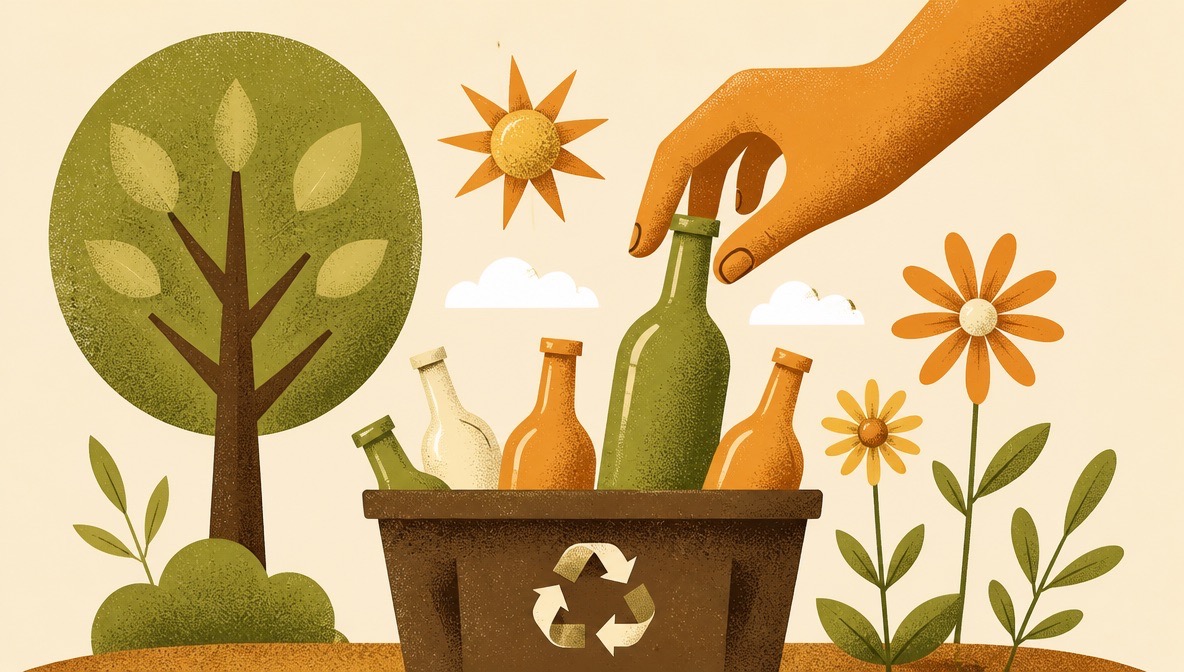
Still, you don't ask someone to lug a breakable object across town on goodwill. You make the trip pay. Here's the whole mechanic in one line: buy Watalog at the store, bring the empty back, collect your cash. Simple to say. Quietly radical in effect. The moment there's money riding on an empty bottle, the entire psychology flips. It stops being a chore and becomes a small IOU you happen to be holding. And people are wired to hate leaving their own money on the table far more than they enjoy scooping up someone else's. Behavioural scientists call it loss aversion. You'd call it the reason you'd walk back into a shop for a refund you technically don't need. The numbers from countries that run this at national scale are almost comic. Germany's deposit system pulls back over 98% of eligible bottles. Norway lives in the nineties. The places that tried the same idea with a token deposit and a painful way to return it slid down into the fifties. The lesson underneath all of it is blunt: people return bottles when the money feels real and the returning feels effortless. Love for the planet barely enters the maths. Self-interest does the lifting, and the planet gets helped anyway. So we made the money feel real and the return feel easy, heavy glass and all. The bottle stopped being something you throw away and became something you cash in. Over time the method kept sharpening, new deals layered on top of the first, each one giving people one more reason to complete the loop.
The part we can't fully tell you
The refund is the visible half. The invisible half is how the loop pays for itself, and that lives inside a deal we struck with the retailers. The short version: everyone handing out the cash had every reason to keep handing it out. The incentives lined up so neatly that returning a bottle was good for the shopper, good for the shop, and good for Watalog at the very same moment. The exact shape of that arrangement stays a trade secret, and honestly, that's the most valuable sentence in this whole essay. Any brand on earth can print "please recycle" on a label. Very few build an economic engine where every party in the chain quietly wants the identical thing to happen. That's the gap between a campaign and a system. Campaigns end. Systems compound.
What actually happened
Within months, more than 180,000 bottles were in circulation. Read that word slowly. Circulation, not units sold. A bottle that comes back and heads out again is holding down several jobs on a single body: it's a product, a piece of media, a reason to walk back into the store, and a quiet unit of sustainability, all at once. The scoreboard stopped measuring how many we sold and started measuring how many were moving. And this is exactly where the two goals people love to treat as enemies turned out to be one goal wearing two hats. Less waste and a better deal were never fighting. The deal was the reason for the lower waste. Nobody brought a bottle back to save a turtle. They brought it back because it was theirs and it was worth something, and the fewer-bottles-in-a-landfill outcome tagged along, uninvited and very welcome.
Then we scaled it
180,000 bottles proved the loop held up in the wild. The next question wrote itself: where else does a returnable, branded bottle earn its keep? The answer had been sitting in front of us the whole time, on every restaurant table we had ever been handed a glass of water at. HORECA runs on water. Hotels, restaurants and cafés pour it all day, at the start of every meal, in every room, on every counter. And here's what kept nagging at us during those store and venue visits: the water on those tables almost always wore somebody else's logo. A third-party brand, parked on the most valuable surface in the room, taking credit that belonged to the venue. Every glass poured was a small free advertisement for a company that had nothing to do with the place. So we kept asking the obvious question out loud: why is this bottle wearing a stranger's name instead of yours? Then demand did the arguing for us. As more venues asked to get in, we rebuilt the system so it could scale without us in the room. We designed Watalog so the bottle could be picked up by anyone and made their own, a kit flexible enough for a five-star hotel, a fine-dining room or a corner café to drop in their own branding in place of a third party's. Same returnable glass. Same cash-back-and-circulation engine humming underneath. Now carrying the venue's identity on the outside. Water shifted from a cost the venue quietly swallowed into a surface the venue proudly owned. That's a very different conversation than "please buy our water." It's "stop giving your best branding real estate away for nothing." And it travelled through deals and contracts, venue by venue, each one turning its own tables into media it finally controlled.
The whole point
You can spend a fortune begging people to do the right thing. Or you can quietly arrange the world so the right thing is also the easy, faintly self-interested thing, and then step out of the way. The shopper brings the bottle back because it's worth money. The venue puts its name on the bottle because the surface was always theirs. Nobody needed a lecture. Everybody had a reason. That's the trick, start to finish, from the first pass to the last contract. Get the incentive right, and the bottle comes back on its own. Then it comes back wearing your name.
Point of view·6 min read·17 August 2026
Self-Interest Does the Recycling.
Zerologic Insights
Get the thinking.
Frameworks and field notes on brand, product, and go-to-market —
sent when there's something worth applying. Not on a schedule.
Keep reading
Start here