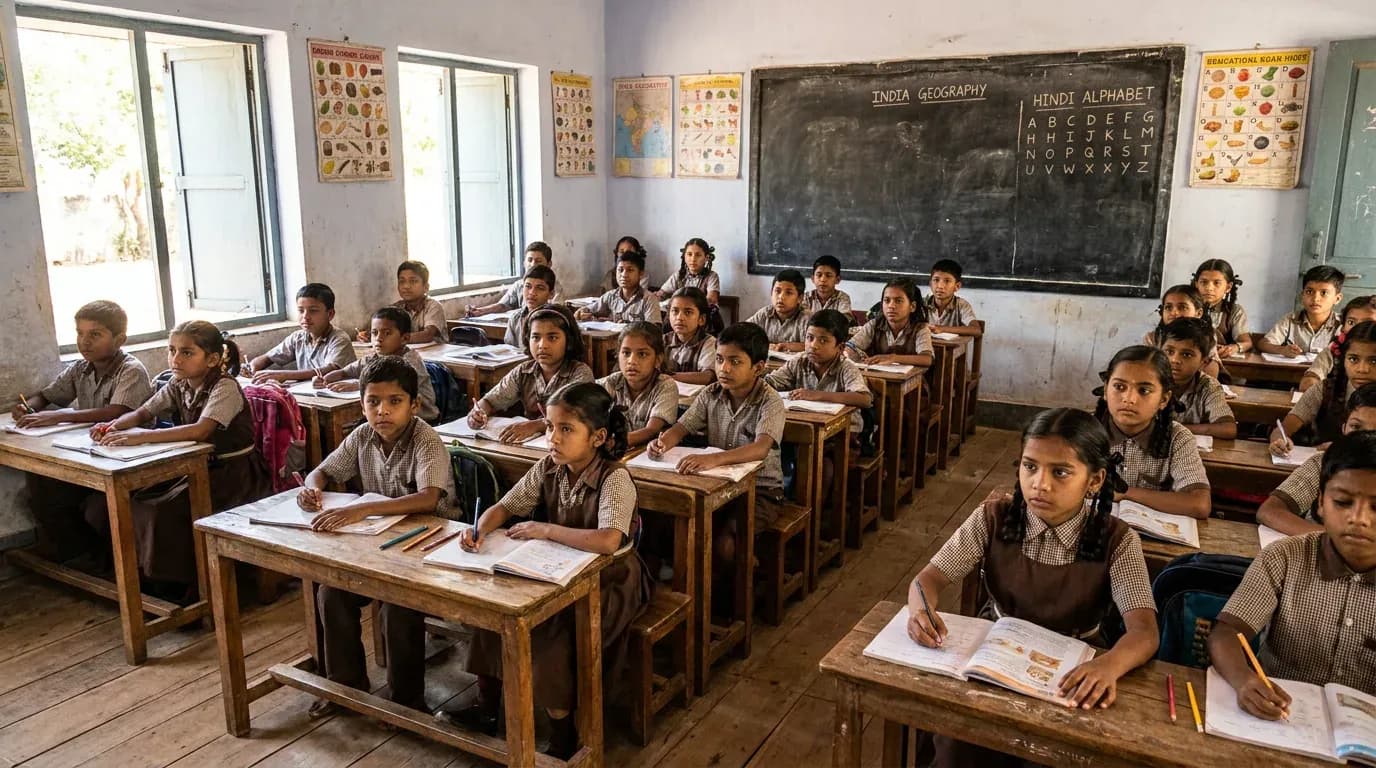
Textbook sales were declining. Zerologic went to the classroom floor to find out why.
The challenge
Shivalal Agarwala & Co. is one of the most prominent educational publishers in northern India. In the years following COVID-19, booksellers across Gwalior and Indore were reporting a marked decline in textbook sales — not a seasonal dip, but a structural pattern. The market that Shivalal had served for generations was changing, and the precise mechanism of that change was not yet understood.
Client
Shivalal Agarwala & Co.
Category
B2B · Educational Publishing · Policy Research
Phase
Define
Capabilities
3 deployed
The insight
The decline in textbook sales was not primarily a distribution problem, a pricing problem, or a competition problem. It was a behaviour change problem rooted in a shift of authority: coaching teachers had displaced schools as the primary organising force in MP Board students' study lives, and coaching teachers did not recommend publisher books — they provided their own notes.
01 · Define
The Field Research Revealed That the Textbook Ecosystem Had Reorganised Around a New Centre of Gravity.
The research design was built around a foundational choice. Zerologic could have administered a survey. The data would have been quantifiable, fast to collect, and easy to present. It would also have missed the thing that mattered most.
The decline in textbook usage among MP Board students was not a fact that students would report cleanly on a form. Students do not typically understand, or articulate, why they study the way they do. They act on cues — from their coaching teacher, from their peer group, from the incentive structure of the exam itself. To understand behaviour, the research had to be conducted in the environments where that behaviour occurred: classrooms, coaching institutes, staff rooms, book markets, and the informal social spaces around them.
Zerologic deployed a qualitative methodology across five days in two cities — Gwalior and Indore — engaging 160+ respondents across four stakeholder categories: MP Board students from both Science and Commerce streams, school teachers from government and private institutions, coaching teachers with an average of fifteen or more years of experience, and booksellers operating in both new and second-hand markets.
The most significant finding was not about textbooks. It was about authority. In the MP Board ecosystem, coaching teachers have displaced schools as the primary guide for how students study, what they buy, and how they prepare for exams. Coaching teachers were not recommending publisher books. They were compiling their own notes from multiple reference sources and providing those notes to students directly. The motivation was partly pedagogical, but also commercial — proprietary notes are a student retention mechanism.
The second major finding concerned the exam structure itself. MP Board exams are built primarily on objective and theoretical questions drawn directly from NCERT content, class notes, and previous year papers. Students had responded rationally: buy a Pariksha Adhyayan question bank in the final weeks before the exam, work through past papers, and pass without engaging with a full textbook during the year.
The third finding concerned the second-hand book market. Booksellers reported that 90% of transactions were now in old books, not new ones. New book sales had declined by an estimated 50% over five years.
The fifth finding pointed toward an opportunity. Teachers consistently noted that the language register of most textbooks was a barrier. Hindi medium students who studied in Hinglish found pure Hindi textbooks difficult to use and pure English content inaccessible. The publisher who closes that gap would occupy a position that no current publisher holds.
The research delivered to Shivalal was a 44-page qualitative field report covering all five fieldwork days, all four stakeholder categories, and the seven systemic trends identified from the data. The report did not offer recommendations. It offered intelligence — the kind that changes what decisions are possible.